
Demystifying the Puppy Kindergarten Curriculum
What to Expect Inside a Modern Puppy Foundation Course
Walking into a good training facility shouldn't feel like entering a strict military academy. It feels like a safe, well-managed learning lab where young dogs explore novelty without feeling overwhelmed. Most programs welcome pups anywhere from 8 weeks to 12 months of age, provided they've started their age-appropriate vaccination series.
Structured early education sets the stage for a calm home. When owners sign up for Classes for Puppy Training, they often expect hours of robotic drills. Instead, the modern curriculum focuses on shaping how a puppy processes the world around them.
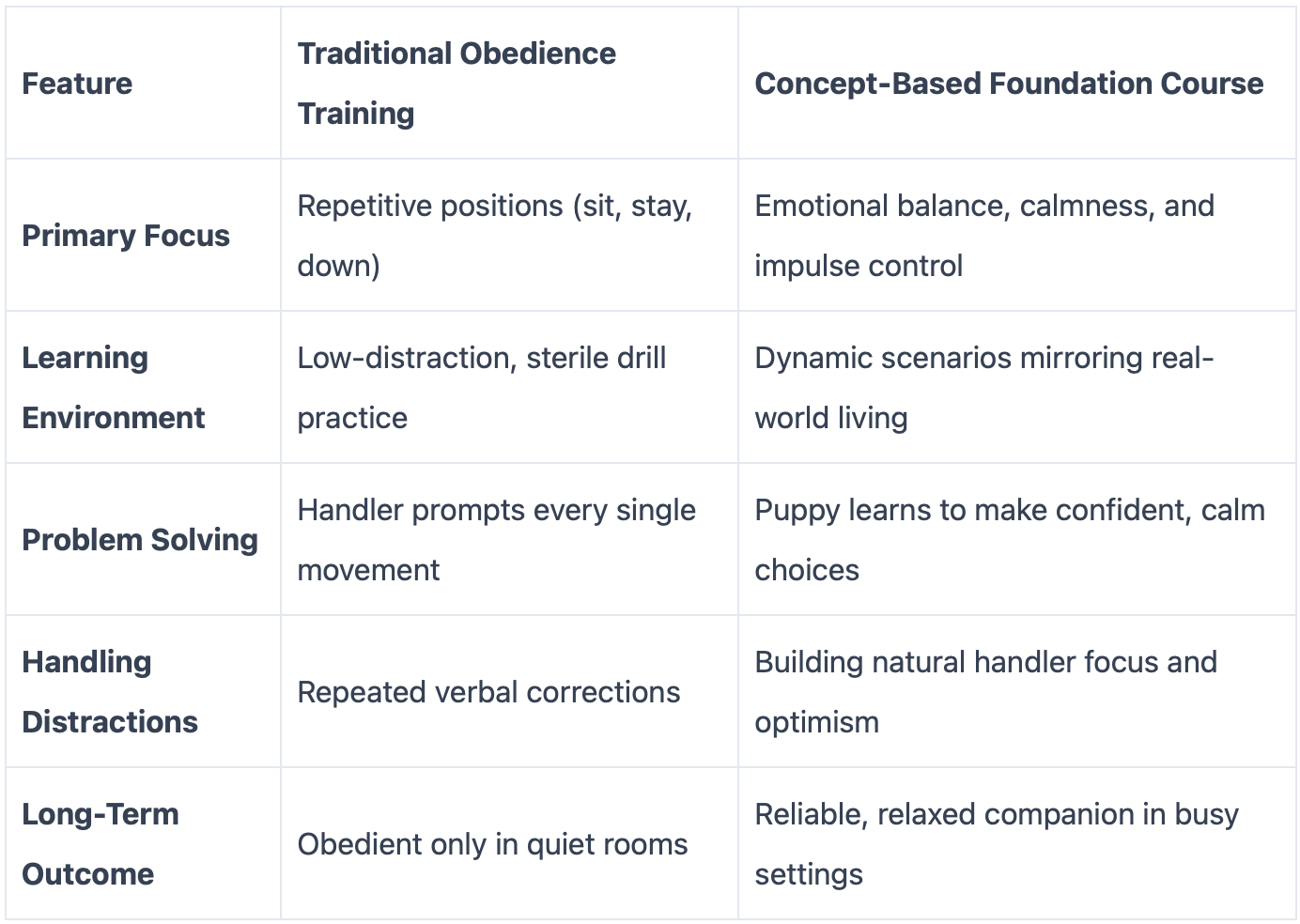
Rather than simply forcing positions, instructors guide dogs to solve puzzles, regulate their impulses, and choose their owners over environmental distractions. Here's how traditional command drills stack up against concept-based learning:
How a Puppy Foundation Course Builds Focus and Calmness
Puppies don't come out of the box knowing how to relax when life gets exciting. Their brains naturally react to everything—a fluttering leaf, a running toddler, or a delivery truck pulling into the driveway. If every new sight sends your pup into overdrive, teaching a simple "sit" won't fix the underlying arousal.
Foundation classes target emotional regulation first. Through interactive micro-games, your puppy learns that checking in with you earns better rewards than lunging after a distraction. We use short games that teach bite inhibition, impulse control, and optimism around strange objects. Learning to decode subtle body signals helps you step in before overstimulation turns into frantic nipping; reading What Your Puppy Is Trying to Tell You gives you a huge head start on catching those stress signals early.
Essential Skills Taught in a Puppy Foundation Course Curriculum
A solid syllabus covers much more than party tricks. The goal is smooth integration into daily family routines across Michigan neighborhoods. Core skills include:
- Loose-leash walking foundations: Teaching your pup that a loose leash moves them forward, while pulling stops the fun.
- Polite greeting manners: Keeping all four paws on the floor when guests or family members arrive.
- Potty and crate structure: Dialing in clean house habits using The Ultimate No-Stress Guide to Puppy House Training so accidents stop derailing your schedule.
- Settling in isolation: Showing your puppy how to relax independently in a crate or on a place mat, preventing separation panic.
- Managed novel exposures: Introducing strange textures, sounds, and controlled visual stimuli without creating fear, a system outlined in Got a Wild Summer Puppy? How Socialization Can Save Your Sanity.

How Puppy Classes Are Structured and Assessed Over Time
Most puppy programs run for 6 to 8 weeks, meeting for 1 to 1.5 hours each week. High-quality programs keep class sizes small, typically capped at 4 to 6 puppy-and-handler teams. That tight ratio guarantees the instructor can spot subtle handling mistakes, manage play styles safely, and give every family direct feedback tailored to their specific lifestyle.
During each weekly module, time is split between hands-on micro-games, handler coaching, controlled exposure setups, and structured calm-down intervals. This rhythm ensures that young puppies never reach mental fatigue or sensory burnout during their lessons. You won't face a high-stress final exam day where one mistake fails your dog. Instructors assess progress continuously over a minimum four-week window.
Throughout this non-competitive progression, trainers observe how comfortably your pup accepts gentle handling, whether they settle near other dogs, and how readily they respond to basic engagement cues. Tuition averages around $285 for a standard 6-week block. When researching local options, checking our breakdown on How to Choose the Best Puppy Foundation Training and Preschool will help you pinpoint coaches who prioritize real-world reliability over empty test certificates.
The Gear You Need Before Your First Day of Class
Showing up prepared lets you focus entirely on your dog instead of fumbling with tangled equipment. You don't need a trunk full of gadgets, but bringing the right tools makes every drill smoother, safer, and far more productive.
Pack these essentials in your training bag:
- Flat buckle collar or clip harness: Fitted securely so your puppy can't back out if startled by a sudden noise.
- Legally compliant ID tag: Clear contact information attached directly to the collar for safety.
- Standard 6-foot leash: Leave the bulky retractable flexi-leads at home; standard nylon or biothane gives you reliable control and consistent feedback.
- High-value training treats: Tiny, soft treats like freeze-dried liver, rolled meat, or string cheese cut into pea-sized bits so your dog can swallow quickly without losing focus.
- Treat pouch: Quick waist access prevents missed reward timing when capturing fleeting moments of calm behavior.
- Grooming brush and clean-up bags: Essential for cooperative handling practice and cleaning up inevitable potty accidents.
Having your gear dialed in before stepping onto the training floor reduces your own stress and lets your puppy settle into the environment quickly. Avoid common early setup traps by reading through 3 Mistakes Families Make When Raising a Puppy and How to Avoid Them.
Why Concept-Based Training Outperforms Rigid Command Drills
Traditional obedience teaches a dog what posture to hold. Concept training teaches a dog how to think. When a puppy faces a sudden novelty—like an umbrella snapping open on a sidewalk in Plymouth or Northville—a robotic "sit" cue often shatters under the sudden spike of adrenaline.
Concept learning reshapes the dog's default emotional bias. We turn naturally cautious, hesitant puppies into optimistic explorers who view novel environments with curiosity rather than fear. You build resilience through short, playful problem-solving games rather than repetitive corrections. Dynamic brain shaping during early development teaches puppies how to disengage from environmental distractions independently, creating true reliability in high-distraction public settings.
Scientific research on early puppy socialization demonstrates that positive, proactive exposure before the primary socialization window closes prevents long-term fear and reactivity down the road.
Consequence-based tools and clear boundaries have a valid place in balanced dog training, especially as puppies mature into strong, willful adolescents. But incorrect tool use or poorly timed pressure can create unnecessary anxiety or long-term behavioral fallout. Working directly alongside an experienced professional ensures that any tool—from food rewards to electronic collars—is introduced fairly, clearly, and humanely. For broader context on setting up long-term stability, check out The Ultimate Guide to Puppy Obedience Training Near You.
Frequently Asked Questions About Early Dog Education
Do puppies need to finish all shots before joining class?
No, puppies do not need to finish their entire 16-week vaccination series before starting a clean, well-managed class. Leading veterinary behavior guidelines highlight that waiting until all shots are complete closes the critical early socialization window. As long as your pup has received their first round of vaccines, remains on a vet-approved booster schedule, and attends a sanitized indoor facility that screens all participants, group learning is both safe and beneficial.
How are puppies evaluated to earn their foundation certificate?
Instructors evaluate puppies through continuous, low-stress observation across class sessions rather than a single pass-or-fail test. Over a minimum four-week evaluation window, the trainer monitors leash walking, polite greeting tendencies, bite inhibition progress, and how smoothly the pup tolerates basic body handling for grooming or veterinary checks.
Can older puppies or adolescent dogs attend?
Yes, many programs accept dogs up to 12 months old. Older pups and juvenile dogs often bring extra physical energy and boundary-testing attitudes to class. Instructors screen older participants to confirm they fit well with the group dynamic, ensuring class exercises match their developmental stage without overwhelming younger classmates.
Building a Lifelong Companion for Your Home
Raising a puppy doesn't have to turn your household upside down. When you replace chaos with clear structure, daily life gets dramatically easier for the whole family.
At Joey Luke's Dog Training, we work with households throughout Livonia, Canton, Plymouth, Novi, Northville, and nearby Detroit suburbs. We know how tricky it is to juggle busy family routines, energetic kids, and an excitable new puppy. That's why our private lessons fit cleanly into hectic weekday schedules without the rigid timing of group classrooms. If you have upcoming trips planned, our board-and-train programs roll high-level foundation training directly into your existing summer travel boarding budget.
We use a balanced approach tailored to each individual dog, including electronic collars when appropriate, giving you clear communication and dependable off-leash control. Check out our complete Puppy Training options to start turning your unpredictable pup into the reliable, well-mannered companion your family deserves.
