
When Your Dog Won't Listen, One Command Can Change Everything
Dog training for the leave it command is one of the most practical and potentially life-saving skills you can teach your dog.
Here is a quick overview of how to teach it:
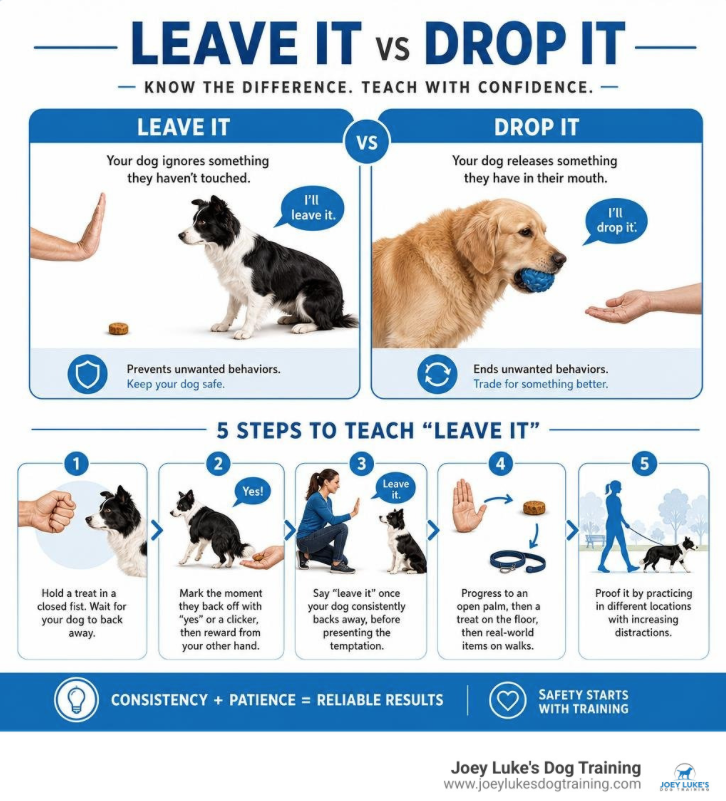
1. Hold a treat in a closed fist. Wait for your dog to back away from your hand.
2. Mark the moment they back off with a word like "yes" or a clicker, then reward from your other hand.
3. Say "leave it" once your dog consistently backs away, before presenting the temptation.
4. Progress to an open palm, then a treat on the floor, then real-world items on walks.
5. Proof it by practicing in different locations with increasing distractions.
Imagine you drop a pill on the kitchen floor, or your dog spots a chicken bone on the sidewalk before you do. In that split second, a reliable "leave it" is the difference between a close call and a vet emergency.
The ASPCA notes that impulse control commands like "leave it" can significantly reduce the risk of dogs ingesting toxic substances or dangerous objects. And according to the American Kennel Club, dogs with strong obedience training are 80% less likely to be involved in accidents or ingest harmful items during walks.
The good news is that any dog, at any age, can learn this command with the right approach.
I'm Joey Luke, and over more than a decade of hands-on dog training for the leave it command and other obedience skills, including years working with high-risk dogs in rescue settings, I have seen this one cue transform chaotic walks and stressful mealtimes into calm, manageable moments. Let's break down exactly how to build it, from the very first session to real-world reliability.
Why Dog Training for Leave It Command is Essential for Safety
When we think about teaching our dogs basic manners, we often focus on flashy tricks or simple sits. However, teaching impulse control is the absolute foundation of a happy life together. Without it, our dogs are simply reacting to every single smell, sound, and scrap of food they encounter.
The leave it command acts as an invisible safety net. It allows us to communicate clearly with our dogs when they need to make a conscious choice to ignore something tempting. This is especially true when it comes to preventing them from swallowing toxic substances. From dropped prescription medications in the bathroom to sugar free gum containing deadly xylitol on the sidewalk, the hazards are everywhere. According to the ASPCA, teaching dogs to master their impulses is the most effective way to prevent accidental poisoning.
Another massive benefit of this training is the prevention of resource guarding. Resource guarding is a natural behavior where dogs become protective over food, toys, or stolen household items. It can escalate quickly from a simple freeze to growling, snapping, or even biting. When we use force to pry a stolen item out of a dog's mouth, we teach them that humans are threat who want to steal their treasures. This actually makes guarding worse.
By using positive reinforcement to teach leave it, we reframe the entire interaction. We teach our dogs that giving up an item is a highly rewarding game. They learn that looking away from a valued object leads to an even better reward from us. This builds trust and prevents the anxiety that drives guarding behaviors. For more insights on how to build this trust, you can read our comprehensive Dog Training Tips to set your household up for success.
To understand the full scope of how this command builds deep focus, you can also check out the official guide on How to Teach Your Dog the 'Leave It' Command which outlines the foundational role of impulse control in canine development.
Leave It vs Drop It and Other Cues
One of the most common mistakes we see pet owners make is using the wrong command for the situation. This leads to confusion for the dog and frustration for the handler. To keep your communication crystal clear, you must understand the difference between leave it, drop it, and the off command.
Leave it is a preventative cue. It means "do not touch, do not sniff, and do not pick up that item." The dog should look away from the object and redirect their focus entirely to you. Once a dog leaves an item, they should understand that they are never going to get that specific item. Instead, they will get a completely different, higher value reward from your hand.
Drop it is a reactive cue. It is used when your dog already has something in their mouth. Whether it is a tennis ball during a game of fetch or a dirty sock they swiped from the laundry basket, drop it means "open your mouth and let go of what you are holding." We teach this by trading them for a treat of equal or greater value, ensuring they do not feel threatened by giving up their prize.
The off command is entirely different. It is used to tell your dog to get their paws off a surface. If your dog is jumping on the kitchen counter to steal a sandwich, or jumping up to greet a guest, the correct cue is off.
To help you remember these crucial differences, let us look at how these scenarios play out in real life:
If your dog is staring at a dropped piece of chocolate on the floor, the correct command is leave it. The goal is to prevent them from ever touching it.
If your dog has already picked up the dropped chocolate, the correct command is drop it. The goal is to get them to release it immediately.
If your dog is putting their paws up on the kitchen counter to reach the chocolate, the correct command is off. The goal is to get their paws back on the ground.
By keeping these cues separate, you prevent your dog from guessing what you want. This clarity is what makes your training reliable when it matters most.
How to Teach the Command from Basics to Advanced
Before you begin your first training session, you need to gather the right tools and set up a perfect learning environment. Success in the early stages depends heavily on making it easy for your dog to win.
First, you need two different types of treats. You will need a low value bait treat, such as regular kibble or a basic biscuit, and a high value reward treat. The reward treat must be something your dog absolutely craves, like freeze dried liver, small pieces of hot dog, or cheese. The secret to leave it training is that the dog must always be rewarded with something better than the item they are ignoring.
Next, choose a quiet environment with zero distractions. Your living room or a quiet hallway is perfect. Turn off the television, put other pets in another room, and make sure there are no toys scattered on the floor.
We highly recommend using marker words or a clicker to pinpoint the exact second your dog makes the right choice. A marker word like "yes" tells your dog exactly which behavior earned them the treat. Additionally, you should establish a clear release cue, such as "okay" or "free," to let your dog know when the training repetition is finished.
If you want professional guidance to help you master these mechanics, our structured Dog Training Lessons are designed to coach you through every step of this process in a supportive setting.
Step by Step Guide to Dog Training for Leave It Command
Now that you are prepared, let us dive into the core training steps. Take your time with each stage, and do not rush to the next step until your dog is fully confident.
Step 1: The Closed Fist
Place a low value bait treat in your fist and close your hand tightly. Hold your fist out toward your dog. Your dog will likely sniff, lick, paw, or even nibble at your hand to get the treat. Do not say anything. Do not scold your dog. Simply wait.
The moment your dog pulls their nose away, even for a split second, mark that exact moment with your word "yes" or a click. Immediately open your other hand to give them a high value reward treat. Repeat this process ten to fifteen times until your dog immediately backs away from your fist the moment you present it.
Step 2: Introducing the Cue
Once your dog consistently backs away from your closed fist, you can introduce the verbal cue. Just before you present your closed fist, say "leave it" in a cheerful, friendly voice. Avoid using a harsh or warning tone. A commanding, angry voice adds unnecessary stress and can damage your dog's willingness to cooperate. When they back away, mark with "yes" and reward them from your opposite hand.
Step 3: Progress to the Open Palm
Now we will increase the difficulty. Place a treat in your open palm. Say "leave it" and present your hand. If your dog lunges for the treat, quickly close your fist to protect it. Do not let them eat it. Wait for them to back away, then mark and reward from your other hand.
This stage teaches your dog that even when food is completely visible and accessible, they must still look to you for permission. For a deeper look at refining this specific hand progression, you can read the classic guide on How to Teach A Dog to "Leave It" - Whole Dog Journal for more troubleshooting tips.
Step 4: Floor Practice
With your dog in a sitting position, place a low value treat on the floor and cover it with your hand. Say "leave it." If your dog tries to get it, keep your hand covering the treat. The moment your dog looks away or looks up at your face, mark "yes" and feed them a high value treat from your pocket.
Slowly progress by lifting your hand slightly off the floor, exposing the treat. If your dog moves toward it, cover it again. Eventually, you should be able to stand up with the treat uncovered on the floor between you and your dog.
Advanced Progression and Real Life Items
Once your dog has mastered the basic floor exercises, it is time to transition to advanced progression. This is where we bridge the gap between classroom practice and real life scenarios.
The first step in advanced progression is the foot cover. Instead of using your hand to cover the treat on the floor, place the treat down, say "leave it," and cover it with your shoe if your dog attempts to grab it. This allows you to stand upright, simulating a more natural posture. It also teaches your dog to respect boundaries even when you are not actively bending down over them.
Next, you must generalize the command by using real life items. Dogs are context specific learners. Just because your dog understands that they should leave a piece of kibble alone does not mean they know they should leave your leather slippers, a dropped tissue, or a plastic toy alone. Practice the exact same steps using these household items.
The ultimate goal of this training is to build automatic permission. We want our dogs to arrive at a "Zen" moment of impulse control where they automatically look to us for guidance whenever they encounter something tempting on the ground, without us even needing to say the words.
If you want to take your dog's obedience to the highest level, our group Training Classes for Dogs offer the perfect environment to practice these advanced skills with professional trainers by your side.
Generalizing and Proofing the Leave It Command
Proofing is the systematic process of testing your dog's understanding of a command across different locations, distances, and levels of distraction. Without proper proofing, you will have a dog who is a superstar in your quiet kitchen but completely ignores you the moment you step out onto the sidewalk.

To proof successfully, you must follow a structured plan. We like to use the 75 percent success rule. During any proofing session, your dog should succeed about 75 percent of the time, allowing for about 25 percent mistakes. If your dog is making more mistakes than that, the exercise is too difficult. You must lower the distraction level, step closer to your dog, or use a higher value reward. If your dog is succeeding 100 percent of the time, the exercise is too easy, and it is time to increase the challenge.
A fantastic advanced proofing game is called Temptation Alley. Set up a straight path in your hallway or backyard. Place several moderately tempting items, like toys, cardboard boxes, or low value treats, along the sides of the path, spaced about eight feet apart. Put your dog on a leash and walk them down the center of the alley. As you approach each item, say "leave it" cheerfully. The moment your dog looks away from the temptation and focuses on you, mark "yes" and reward them with a premium treat.
Once they can handle Temptation Alley, take your training on the road. Practice during your daily walks in Northville MI. Start in quiet residential areas before moving to busier parks. Remember to keep your sessions short, ideally under five minutes, to prevent mental fatigue.
Our specialized Dog Training for Dogs program is designed specifically to help dogs generalize their obedience skills to the real world, ensuring they listen to you no matter where your adventures take you.
Frequently Asked Questions about Leave It Training
How long does it take to teach leave it
Most dogs can grasp the basic concept of leaving a treat in a closed hand within a single ten minute session. However, building a rock solid, real world leave it command that works around high value temptations, like running squirrels or dropped fast food, takes consistent daily practice over several weeks.
We recommend practicing in short, three to five minute sessions, two to three times a day. If you stay consistent, you can expect a highly reliable response in most everyday situations within four to six weeks.
Troubleshooting Dog Training for Leave It Command Setbacks
It is completely normal to experience setbacks during your training journey. If your dog suddenly starts struggling with impulse control, do not panic. Simply take a step back to an easier stage where your dog was previously successful, and rebuild their confidence.
When troubleshooting, keep an eye out for these common mistakes:
*Repeating the command:** If you say "leave it, leave it, leave it" over and over, you teach your dog that they do not have to listen to the first cue. Only say the command once.
*Rewarding with the forbidden item:** Never let your dog eat the treat that you told them to leave. Doing so completely ruins the concept of the command. The reward must always come from your other hand or your pocket.
*Moving too fast:** If your dog fails three times in a row, you have increased the difficulty too quickly. Go back to the previous step.
*Using low value rewards:** If your dog is ignoring you, your treats might not be exciting enough. Swap out dry biscuits for high value options like hot dogs or roast chicken.
What are the common mistakes in puppy vs adult dog training
Puppies are naturally mouthy, curious, and have very short attention spans. When training a puppy, keep your sessions incredibly short, around one to two minutes. Focus heavily on gentle redirection, and never use physical corrections. Puppies are still learning how the world works, so patience is key.
Adult dogs often have more focus, but they may also have deeply ingrained habits, such as scavenging for trash on walks. When training an adult dog, you may need to spend more time breaking old patterns. Use extra high value rewards to compete with their established habits, and focus on building a strong history of positive reinforcement.
So If You’re Ready to Teach That Leave It and Drop It
At Joey Luke's Dog Training, we believe that every dog has the potential to become a well behaved companion. Our passion is helping families in Northville MI and throughout Michigan transform unpredictable, stressful pets into calm, reliable family members.
Teaching your dog to leave it is more than just an obedience exercise; it is an investment in their safety and your peace of mind. By building strong impulse control, you create a deeper bond of trust and communication with your furry best friend.
If you are ready to take the next step in your training journey, explore our full range of professional Services today. Whether you need help with basic manners or advanced real world proofing, we are here to support you every step of the way!
