
To Couch or Not to Couch: Dog Training for Furniture Rules
Does Your Dog Own the Couch? What Every Owner Needs to Know About Furniture Rules

Dog training for furniture rules is one of the most common challenges families face — and the good news is, it's very solvable.
Here's a quick overview of how to handle it:
1. Decide your rule first — 100% off-limits, or permission-only access
2. Be consistent — every person in the house must follow the same rule, every time
3. Teach a clear command — "off" to remove your dog, "place" to redirect them
4. Provide a comfortable alternative — a cozy dog bed in the same room
5. Manage the environment — use baby gates or crates when you're not home to supervise
Picture this: you've had a long day, you finally sit down on the couch, and your dog is already there — sprawled across the best cushion, looking completely unbothered.
Sound familiar?
You're not alone. For busy families, an unruly dog claiming the furniture isn't just annoying — it adds real stress to an already hectic household. And when one family member lets the dog up while another doesn't, the confusion makes things worse for everyone, including your dog.
The truth is, there's no single right answer about whether dogs should be on furniture. What matters most is having a clear, consistent rule — and knowing how to actually enforce it.
This guide walks you through everything: why dogs are drawn to your couch in the first place, which training methods work, and how to stop the sneaky sofa surfing that happens the moment you leave the room.

Understanding Why Your Dog Covets the Couch
To successfully implement dog training for furniture rules, we must first understand why our dogs are so drawn to our seating in the first place. It isn't just about defiance or trying to "rule the roost." In fact, old-school theories claiming that dogs sit on furniture to establish dominance or view themselves as the "pack leader" have been thoroughly debunked by modern veterinary science.
Instead, the reasons are much more practical and deeply rooted in canine psychology:
*Comfort:** Simply put, your couch is comfortable! Dogs naturally seek out soft, warm, and supportive surfaces to rest their joints. This is especially true for senior dogs or large breeds prone to arthritis, who desperately need pressure relief.
*Elevation:** In the wild, high vantage points provide safety and a clear view of the surrounding territory. In your living room, the couch serves as a lookout tower where your dog can monitor the household, watch for squirrels out the window, or keep an eye on their favorite humans.
*Owner's Scent:** Your furniture is saturated with your scent. Because dogs are incredibly social pack animals, they seek out places that smell strongly of you to feel secure, especially when you are away.
*Anxiety and Boredom:** A lonely or anxious dog will often seek out the couch for a sense of closeness. If they are bored, the couch might also become a giant chew toy or a launching pad for zoomies.
Addressing the Root Causes of Furniture Seeking
Before we can expect our dogs to respect our furniture boundaries, we must address their emotional and physical needs. Redirection is only successful when the alternative we provide is just as satisfying as the couch itself.
If your dog is turning to the furniture out of boredom or stress, increasing their daily mental stimulation and physical exercise is your first line of defense. According to behavior experts, providing dogs with appropriate chew toys and mental stimulation reduces destructive chewing incidents by up to 80%. Chewing is a natural, species-specific behavior that releases calming endorphins. If we do not provide a designated outlet like a frozen food-stuffed toy, they will find their own outlet — which often ends up being your expensive wooden table legs or sofa cushions.
Furthermore, dogs who receive consistent training and clear boundaries are 70% less likely to develop destructive behaviors such as chewing furniture. When we proactively meet our dogs' needs, we make it much easier for them to make the right choices. If you are struggling to manage a stressed or destructive pup, implementing structured Dog training tips for managing anxiety can help restore peace to your home.
Establishing Clear Boundaries: To Couch or Not to Couch?
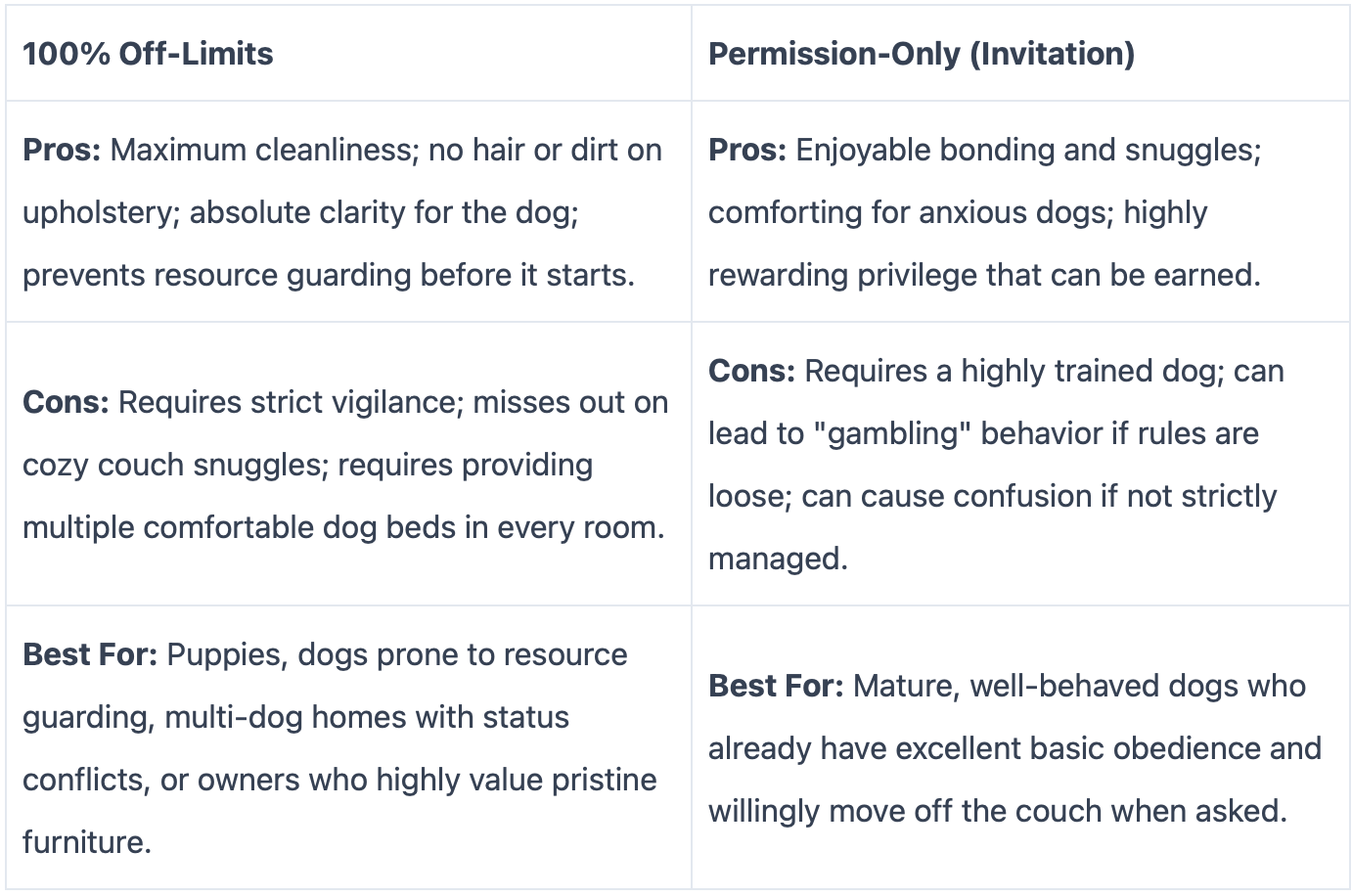
Deciding whether to allow your dog on the furniture is a highly personal decision. There is no universal "right" way to handle this. Some owners love nothing more than snuggling with their pups on the sofa, while others prefer a hair-free, mud-free seating area.
What matters most is that you make a firm decision and stick to it. Inconsistency is the ultimate enemy of successful dog training. If you allow your dog on the couch on Friday night while watching a movie, but scold them on Saturday morning when they have muddy paws, you confuse them. Dogs think in black and white; they do not understand "sometimes."
To help you decide which approach is best for your household, consider this comparison:
Puppy Milestones and Dog Training for Furniture Rules
If you are raising a puppy, the golden rule of dog training for furniture rules is to start immediately. It is far easier to prevent a habit from forming than it is to break one later.
Puppies that are not taught furniture rules by 6 months of age are significantly more likely to continue the behavior into adulthood, with many owners reporting ongoing issues past 1 year. During the first few months of life, puppies are learning how the household works. If they are allowed free access to the couch early on, they will naturally assume they have permanent, lifetime permission.
For young puppies, we recommend starting with "level training." This concept relies on the puppy's natural perception of space: keeping the puppy at floor level passively communicates household boundaries while they are still learning the ropes. If a young puppy gets too hyper or overstimulated on the furniture, they are simply too young to handle that level of freedom.
To build a solid foundation, check out these step-by-step guides on How to train your puppy not to jump on furniture. Once your puppy reaches at least 6 months of age and has a rock-solid understanding of basic obedience, you can gradually transition to permission-only training if you choose.
Essential Commands and Techniques
Training your dog to respect furniture boundaries should always rely on positive reinforcement, luring, and redirection. We want our dogs to choose the floor or their bed because it is highly rewarding, not because they are afraid of the consequences of jumping up.
Teaching the 'Off' and 'Place' Commands for Dog Training for Furniture Rules
The two most powerful tools in your training arsenal are the "Off" and "Place" commands. We use the word "Off" rather than "Down" for furniture, as "Down" should be reserved exclusively for the physical act of lying down on the ground.
To teach the "Off" command, follow this simple sequence:
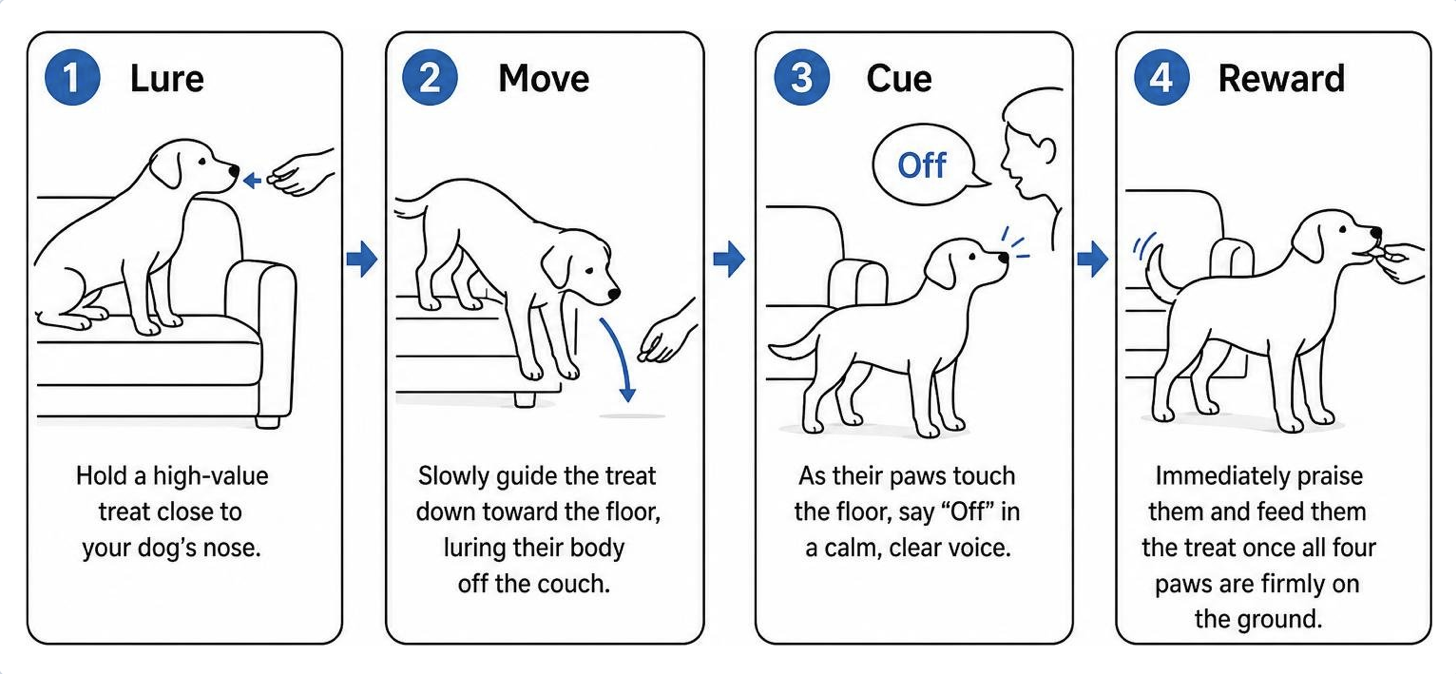
1. Lure: When your dog is on the furniture, hold a high-value treat close to their nose.
2. Move: Slowly guide the treat down toward the floor, luring their body off the couch.
3. Cue: As their paws touch the floor, say "Off" in a calm, clear voice.
4. Reward: Immediately praise them and feed them the treat once all four paws are firmly on the ground.
Once your dog understands "Off," you can introduce the "Place" command. "Place" is a game-changer because it gives your dog a specific, highly rewarding job to do. Instead of just telling them what not to do, you are telling them exactly where to go.
Choose a comfortable, designated dog bed or a raised cot as their "place." Guide them to it, reward them for stepping onto it, and gradually build up the "3 Ds":
*Duration:** Expecting them to stay on their bed for longer periods.
*Distance:** Moving further away from the bed while they remain in place.
*Distraction:** Practicing while household activity occurs around them.
For families looking to master these foundational skills under expert guidance, our structured Obedience classes for dogs are designed to make these boundaries second nature.
Permission Training and the 'Up' Cue
If you decide to allow your dog on the furniture occasionally, you must establish an "invitation-only" policy. Your dog must learn that the couch is a privilege to be earned, not a right.
To teach permission training, require your dog to sit and look at you before getting on the couch. Use a specific verbal cue like "Up" or "Couch" accompanied by a physical invitation, such as tapping the cushion. If they try to jump up without an invitation, immediately use your "Off" command and redirect them to their bed.
A highly effective visual aid for this is the blanket method. Choose a specific, easily recognizable blanket or towel. Your dog is only allowed on the couch when this blanket is laid out. If the blanket is put away, the couch is strictly off-limits. This provides a clear, unmistakable visual cue that helps your dog make the right choice, even when visiting friends or staying in hotels. For more detailed tips on managing permission-based access, read about How to keep your dog off the couch and other furniture.
Environmental Management and Preventing Secret Sofa Surfing
What happens when you aren't home to enforce the rules? Many owners return home to find warm spots on the cushions and fresh hair on the upholstery — proof of "secret" sofa surfing.
Dogs left unsupervised without confinement or training are far more likely to access off-limits areas, with separation anxiety cases showing the highest rates of furniture seeking and destructive behavior. To prevent this, you must manage the environment when you cannot actively supervise.
*Crate Training:** A crate is an excellent management tool. It provides a safe, cozy den for your dog and completely prevents unsupervised furniture access or destructive chewing.
*Physical Barriers:** Use baby gates to block access to rooms with valuable furniture.
*Visual and Physical Deterrents:** Place upside-down laundry baskets, folded cardboard boxes, or cookie sheets on the couch cushions when you leave. These make the couch physically inaccessible and unappealing.
*Scent Association:** Place an old t-shirt that smells like you directly in your dog's bed. Because dogs seek the comfort of your scent, having it on their own bed makes their resting spot far more enticing than the empty couch.
Proactive environmental design is just as important as active training. To build a comprehensive home management system, consider scheduling structured [Dog training lessons for home management](https://www.joeylukesdogtraining.com/dog-training-lessons) to set your living space up for absolute success.
Use Training Tools With Clarity, Not Guesswork
Furniture rules work best when your dog understands exactly what earns access and what ends it. That can include rewards, leash guidance, place work, and, in some balanced training plans, properly fitted and professionally introduced tools.
The key is correct usage. Consequence based training can have a valid place, but incorrect use can cause long term harm or make the furniture problem more confusing. If you're considering an e collar, prong collar, slip lead, or any other training tool, work with an experienced professional who can show you timing, fit, pressure, release, and when the tool isn't the right choice.
Don't physically wrestle a dog off the couch, especially if they stiffen, freeze, growl, or guard the space. Instead, create movement with a known cue, leash guidance if appropriate, or a high value reward, then send them to their place and follow through calmly. For more context on couch specific boundary training, this guide to keeping dogs off furniture offers additional homeowner friendly ideas.
Frequently Asked Questions about Dog Training for Furniture Rules
Why does my dog jump on the furniture as soon as I leave the house?
Your dog isn't doing this to spite you. When you leave, they experience a natural dip in security and seek out comfort. Your couch smells strongly of you, and its elevated position allows them to monitor doors and windows for your return.
To stop this, use environmental management. Confine your dog to a safe, dog-proofed room or use a crate when you are away. Ensure they have a highly comfortable bed of their own, paired with a long-lasting chew toy to keep them occupied and mentally stimulated.
What should I do if my dog growls when I try to get them off the couch?
Growling on the furniture is a classic sign of resource guarding. Your dog views the couch as a highly valuable resource and is using body language to warn you to stay away.
Never physically confront, yell at, or force a growling dog off the couch. Doing so can escalate the situation into a bite. Instead, walk into the kitchen, grab a high-value treat, or squeak a favorite toy to lure them off the couch voluntarily. Once they are safely on the floor, reward them.
Because resource guarding can escalate quickly, we highly recommend seeking immediate professional guidance to address this behavior safely and effectively.
Can older dogs be trained to stay off the sofa if they have done it for years?
Absolutely! While it may take a bit more time, patience, and repetition to override years of habit, senior dogs are entirely capable of learning new boundaries.
The key is to make their alternative resting spot incredibly appealing. Ensure your senior dog has a high-quality orthopedic memory foam bed that supports their joints, and place it in a warm, draft-free spot near the family. Pair this comfortable setup with consistent redirection and high-value rewards every time they choose their bed over your couch.
Ready for a Couch Truce?
At Joey Luke's Dog Training, we believe that your home should be a sanctuary, not a battleground. Our core mission is to help families transform unpredictable, stressful pets into well-behaved, balanced companions who respect household boundaries.
Whether you choose to share your sofa or reclaim your living room entirely, clear communication and unwavering consistency are the keys to long-term success. If you reside in Northville, MI, or the surrounding Michigan areas and need professional help establishing clear household rules, we are here to support you every step of the way.
Ready to transform your home and build a better relationship with your pup? Schedule professional dog training services with us today!
