
The Truth About Board and Trains for Dogs
Life with kids and a dog in a suburban home like Commerce Township or Livonia is pure wonderful chaos. Between soccer practice, school runs, and work, your daily calendar fills up fast. When your dog starts barking at every falling leaf or jumping on guests, finding two hours every night for repetitive training feels completely impossible.
That's why board and train for dogs looks like an absolute lifesaver. You send your wild pup away for a couple of weeks, and they come back polite, calm, and fully trained. It sounds like magic, especially if you're already planning a family trip.
Connecting training with your vacation schedule is actually a brilliant strategy. If you're going to pay for boarding while you lie on a beach anyway, turning that time into learning time makes complete practical sense. Check out our Summer Vacation Dog Board and Training details to see how seamless that timing can be.
Why a Jump Start at a Board and Train Facility Can Help
Professional trainers can accomplish a lot in a short amount of time because they do this every single day. They possess the skill to catch micro behaviors and reward them instantly. That timing builds strong behavioral foundations much faster than a tired parent can after a chaotic ten hour workday.
A good facility also exposes your pup to controlled socialization. Meeting new people or learning polite play around different breeds, like a boisterous Frenchie, happens safely under expert supervision. The initial progress feels fast because the dog gets dozens of repetitions daily in a dedicated environment.
Comparing Costs Between Programs and Private Lessons
Let's talk about the elephant in the room: the price tag. A typical program runs around 2,800 dollars for two to three weeks. Some places charge that same 2,800 dollars for three weeks and then tack on an extra 500 dollars for a single half day owner training session.
Compare that to traditional group family classes or private lessons. A six week family class might run around 140 to 150 dollars. That means a board program costs nearly twenty times more than basic classes.
Is it worth the extra cash? The answer comes down to your time, your budget, and what you need help with. Paying a professional to do the heavy lifting up front offers immense value, but only if those results actually stick when your dog comes home to your living room in Novi or Canton.
The Hidden Risks and Disadvantages You Need to Watch For
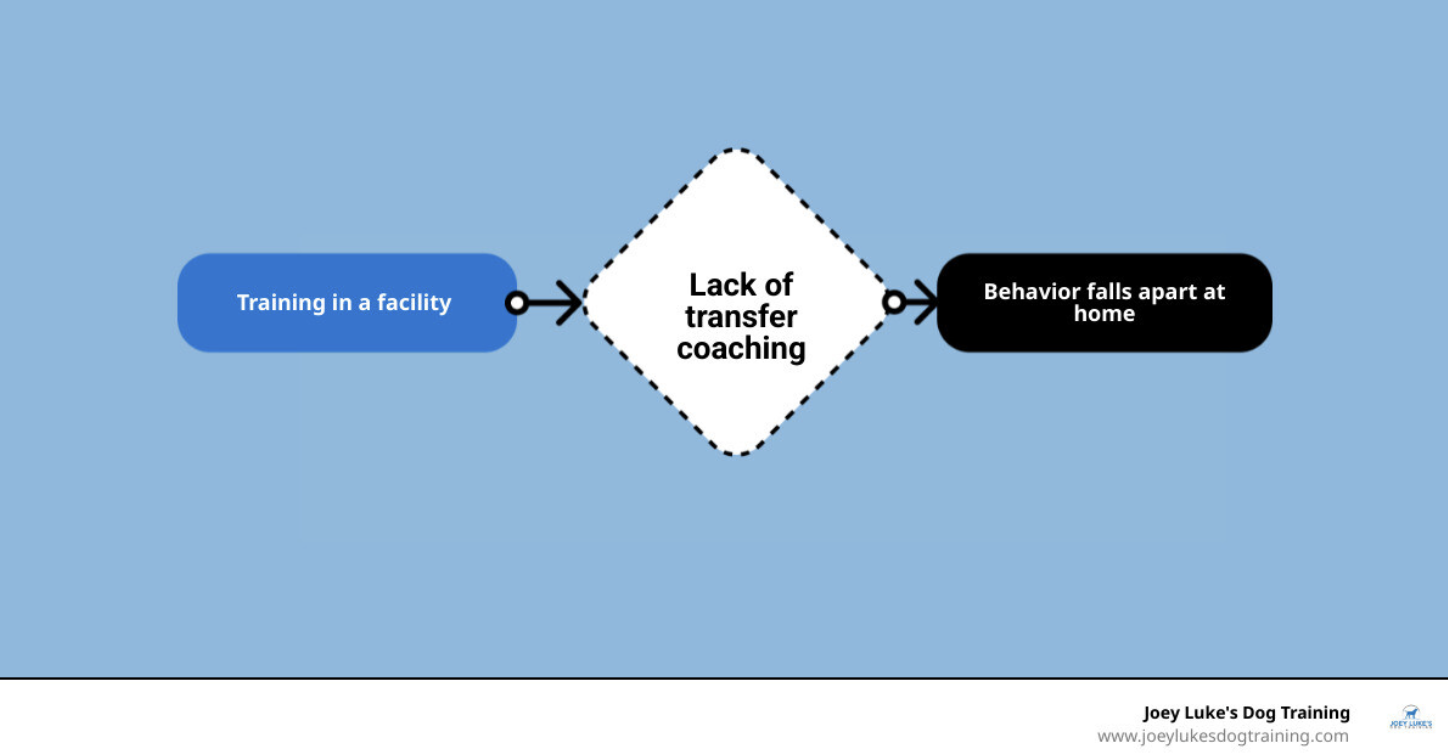
The biggest secret in the pet industry is that dogs are notoriously bad at generalizing. Learning a behavior in a quiet facility yard isn't the same as doing it in your entry hall when the doorbell rings.
If your pup learns to sit politely for a trainer in a controlled setting, they don't automatically realize that rule applies to the kids dropping popcorn on the rug in West Bloomfield.
Another hidden risk is sending your dog into any program without understanding the trainer's actual approach. Before sending your pup anywhere, read Sending Your Reactive Pup to Camp: The Truth About Board and Train Programs to understand what happens behind closed doors.
How Training Tools Can Help When They're Used Correctly
Consequence based training can absolutely have a place, especially when a dog needs clear, consistent information in situations that are stressful, unsafe, or hard to practice at home. Tools like e collars aren't automatically the villain in the story. The real issue is whether the person using them has the experience, timing, and judgment to teach fairly instead of just creating confusion or fear.
Official guidelines from the American Veterinary Society of Animal Behavior highlight why training tools and consequences need to be applied thoughtfully. If pressure, corrections, or equipment are used incorrectly, the dog may stop showing the behavior on the surface while the stress underneath keeps growing.
That's why the answer isn't to avoid these tools entirely. It's to work with an experienced professional who understands both the benefits and the risks, and who knows when a tool is appropriate, when it isn't, and how to coach the family before the dog comes home.
If you're dealing with a dog who barks or lunges on leash, don't just hand the leash to the cheapest or loudest trainer on the internet. Our guide Should You Send Your Reactive Dog Away to Be Fixed? breaks down why reactive dogs need thoughtful care, skilled handling, and a plan that fits real life.
Why Context Matters When Dogs Learn New Habits
Dogs associate learning directly with their immediate surroundings. A cue learned in a specialized facility with a calm trainer is tied to that specific room, those specific smells, and that specific voice.
When your pup steps back into your home in South Lyon or Rochester Hills, all those environmental cues vanish. The distraction level rockets skyward. Your voice has a different pitch, your energy's different, and the kids are running through the kitchen. Without proper transfer coaching, all that expensive training can evaporate in forty eight hours.
How to Choose a Safe and Effective Program for Your Pup
If you decide a stay away program is the right path, you must vet the facility thoroughly. Never hand over your leash based solely on a slick website or cute Instagram clips.
Start by visiting in person. Any trustworthy facility will gladly give you a full tour of where your dog sleeps, plays, and learns. If a provider refuses to let you past the front desk, walk away immediately.
While you're there, watch how the staff interacts with the animals. Are the dogs happy, relaxed, and eager to work? Or do they look stiff, anxious, and fearful? Your gut reaction is usually right. Take a look at Finding a Trusted Board and Train Program for Your Dog for more smart tips on screening facilities.
Crucial Owner Training for Long Term Success
Here's a simple truth: dog behavior is driven by owner behavior. You can send your dog away to a master trainer for a month, but if you don't change how you interact with your pup at home, the old habits will return.
A quality program spends almost as much time training you as they do training your dog. You need hands on coaching to learn proper handler habits, reward timing, and how to set boundaries clearly.
If you prefer to skip the boarding part entirely and learn together as a team right in your home town of Northville or Farmington, exploring our Dog Training Lessons might be the perfect fit for your family schedule.
Essential Questions to Ask Before You Hand Over the Leash
Don't be shy about asking hard questions before signing a contract. You're entrusting a family member to their care.
Find out what specific training equipment they use on the dogs and what happens if your pup makes a mistake during a session. Ask directly if electric collars, prong collars, or choke chains are ever used. You should also ask to tour the sleeping quarters and training areas right then and there. Make sure to clarify how many owner coaching sessions are included in the price, along with the kind of follow up support they offer after your dog comes home.
If a trainer uses vague terms like balanced approach or state of the art tools without explaining what they mean, press for details. Transparency is everything when it comes to your dog's physical and emotional safety.
Frequently Asked Questions
Is board and train for dogs right for my chaotic family schedule?
It can be a fantastic option if you're completely overwhelmed and need a professional to establish basic behaviors first. It fits busy families who are traveling or going through major life transitions. However, you still have to commit time at the end for handler coaching. If you want more answers to common questions, browse through our FAQs page.
How does context affect dogs after they come home?
Dogs learn in context. A behavior learned at a facility doesn't automatically mean the dog knows how to perform it on your glossy kitchen floors in Troy or Royal Oak. You have to bridge that gap by practicing the same cues in your everyday home environment until the dog realizes the rules are the same everywhere.
What happens if an owner skips the handler training portion?
The training almost always breaks down. If the dog returns home and realizes you don't use the same cues, reward timing, or boundaries as the trainer, they will quickly regress to their old habits. Consistent owner follow through is the only thing that guarantees long term success. You can explore all our options on our Services page.
How Joey Luke's Dog Training Helps Your Family Succeed
We know what life with kids and dogs in local neighborhoods like Birmingham, Bloomfield Hills, and Livonia actually looks like. You don't need rigid, unrealistic expectations or military precision. You just need a well mannered companion who fits comfortably into your daily family chaos.
We focus on practical, reward based solutions that build real trust between your family and your dog. Whether you choose a stay away program or hands on private coaching in your living room, we make sure you get the support, tools, and confidence required for permanent results.
Ready to transform your unpredictable pet into the calm companion your family deserves? Take a look at our complete Dog Boarding Training options today, or reach out directly through our Contact page to chat about your dog.
