
How to Choose the Best Puppy Foundation Training and Preschool
How to Find the Perfect Puppy Preschool Near Me Without the Stress
Looking for a puppy preschool near me? Here's what you need to know right now:
There's a narrow window in your puppy's development where socialization does the most good. It closes faster than you'd think. Getting your pup into the right class before 15 weeks isn't just a nice idea, it's one of the highest impact things you can do for your dog's future behavior.
And if your house currently looks like a tiny tornado with paws is running it, you're not alone. Most families feel completely blindsided by how much energy and chaos a new puppy brings. The good news is that the right preschool class can genuinely change the trajectory, and fast.
I'm Joey Luke, and I started working with dogs over a decade ago in rescue environments, helping some of the most challenging dogs imaginable find their footing before finding their families. That background shapes everything about how I approach puppy preschool near me questions, because I've seen what early, thoughtful training does for a dog's entire life.

Why the Right Puppy Preschool Is an Absolute Sanity Saver
Bringing a new puppy into a busy household is a lot like adding a very cute, very destructive toddler to the mix. Your schedule's already packed with soccer practice, school runs, and endless laundry. Suddenly you have a furry family member who treats your favorite shoes like a chew toy and your rug like a patch of grass.
When you start searching for a puppy preschool near me you're not just looking for a place to teach your dog to sit. You're looking for a sanity saver. The early weeks of a dog's life are incredibly precious when it comes to brain development.
During this time, your puppy's forming permanent ideas about the world. They're deciding whether new people, other dogs, and strange noises are safe or scary. This is why structured socialization is so critical.
Research shows that early, positive experiences during this window can prevent behavioral issues down the road. You can read more about this in the Scientific research on puppy socialization and behavior which highlights how proper exposure shapes a stable adult dog. We don't want your pup to grow up feeling anxious or afraid.
Our goal with puppy training is to help you navigate this developmental stage without losing your mind. We focus on building a strong bond between you and your new companion. When you get this foundation right, everything else becomes much easier.
What Actually Happens Inside a Really Good Puppy Class
If you picture a puppy class as a chaotic free for all where dogs just wrestle on the floor, you might be surprised by how structured a good class actually is. Proper classes are designed to teach essential life skills in a calm, controlled way.
We focus heavily on basic manners and teaching your puppy how to focus on you even when there are lots of exciting things happening nearby. This starts with reward based techniques. Force and fear have no place in our classes.
Instead, we use high value treats like tiny pieces of cheese or chicken to make learning fun. Your puppy will quickly realize that paying attention to you is the most rewarding game in town.
One of our favorite exercises is teaching a puppy to settle on a mat or a towel. Bringing an old yoga mat to class gives your pup a clear physical boundary. It becomes their safe zone where they learn to relax and watch the world go by.
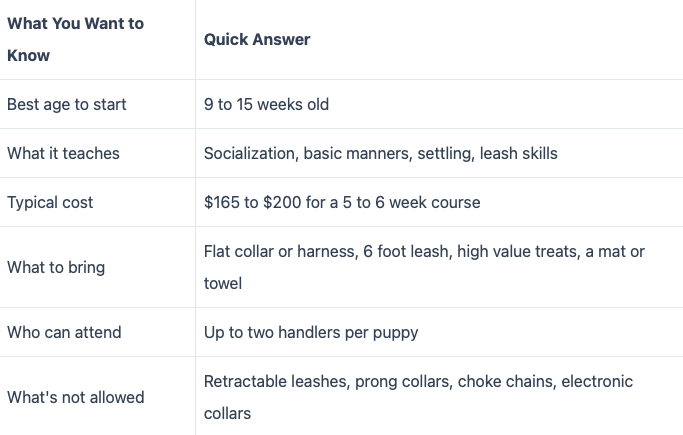
To keep everyone safe and focused, we have clear rules about the gear you use. Every dog must be on a standard flat collar or harness and a regular six foot leash.
We don't allow retractable flexi leashes. Those retractable lines make it too hard to control your dog and can easily get tangled. Harsh tools like prong collars, choke chains, and electronic collars are also prohibited in our classes.
If you want to set your dog up for success, checking out structured classes for puppy training is a great first step. You can also read through our favorite dog training tips to start practicing some simple focus games at home before your first session.
What It Costs and What to Expect Before Your First Day
Understanding the logistics before you enroll can save you a lot of stress. Puppy preschool classes are typically broken down by precise age brackets to ensure safety and developmental alignment.
Preschool is generally designed for puppies who are between nine and fifteen weeks old at the start of the course. This ensures that all the puppies in the room are at a similar stage of physical and mental development.
Before your puppy can attend their first day, you'll need to show proof of age appropriate vaccinations. This usually includes their first round of distemper and parvovirus shots. Keeping the environment clean and requiring vaccinations helps protect all the young pups who are still building up their immune systems.
When it comes to pricing, costs can vary depending on your location and the length of the course. For example, a typical high quality six week course might cost around 200 dollars. Other programs might run about 165 dollars for five weeks.
These prices are very standard across the industry for high quality instruction. Most courses run for five to six weeks, meeting once a week for about an hour.
To keep the classroom environment calm and prevent overcrowding, attendance's usually limited to two people per pet. This is actually great for families because it allows both parents, or a parent and a child, to learn the training techniques together.
As we look ahead in July 2026, finding a class that fits your schedule's easier than ever. If you're looking for structured environments to build these skills, exploring obedience classes for dogs can give you a great idea of what lies ahead. Investing in training classes for dogs early on will save you time, money, and frustration in the long run.
What to Do When Group Classes Feel Like Too Much Chaos
Sometimes, a busy group class isn't the right fit for every puppy or every family. If your pup's particularly timid, or if they show signs of fear when they see other dogs, a crowded room can actually make things worse.
We screen puppies to make sure they're ready for a group environment. If your puppy's hiding under your chair or growling in fear, forcing them to stay in the room can cause long term behavioral issues.
Your family schedule might also be too hectic to commit to a specific class time every week. Between work, kids, and household chores, adding another weekly appointment can feel like too much.
That's where we come in. At Joey Luke's Dog Training, we specialize in helping families in Livonia Michigan and the surrounding Detroit suburbs find solutions that actually work for their real lives.
If group classes feel too overwhelming, private lessons are a fantastic alternative. We can work with you one on one to address your puppy's specific needs on a schedule that fits your life.
We also offer board and train programs, which are incredibly popular for busy families. Many families already plan to board their dogs during summer travel. Reframing that boarding window into a training opportunity is a smart way to use your budget to produce real, lasting results.
Whether you choose private coaching or our hands on boarding programs, we focus on transforming unpredictable pets into well behaved companions. You can explore our customized dog training for dogs options to find the perfect fit. Our tailored dog training lessons are designed to take the stress out of raising your new best friend.
Questions We Get Asked All the Time
How do I know if a puppy preschool near me is safe?
A safe puppy class will always require proof of vaccinations from every single participant before they set foot in the building. The facility should be clean, sanitized, and run by professional trainers who use positive reinforcement methods. You should also look for classes that limit the number of dogs and handlers to keep the environment calm. If you have more questions about what to look for, you can check out our detailed faqs page.
What age should my baby dog start a puppy preschool near me?
The sweet spot for starting puppy preschool is between nine and fifteen weeks of age. This is a critical developmental window where your puppy's highly receptive to new experiences and socialization. Starting early helps them build confidence before they enter their teenage fear phases. To learn more about how we structure early learning, visit our puppy training landing page.
How do I handle a puppy that barks constantly during training?
Barking is a very normal way for puppies to express excitement, frustration, or fear. In a class setting, we handle this by using distraction management and positive redirection rather than scolding. We teach your puppy that quiet behavior is what gets them the tasty treat. If you're struggling with a noisy pup at home, our guide on puppy training barking offers practical steps to help restore peace to your living room.
Let's Get Your Puppy Started on the Right Paw
Raising a puppy is a journey filled with incredible joy and a fair share of muddy paws and chewed up socks. You don't have to navigate the chaos alone.
Our team is dedicated to providing family friendly training that fits into your busy suburban lifestyle. We want to help you build a trusting, respectful relationship with your dog so they can grow into the calm, polite companion you've always wanted.
If you want to learn more about our team and our positive training philosophy, head over to our about page. When you're ready to take the next step toward a more peaceful household, you can reach out to us through our contact page. Let's work together to get your puppy started on the right paw with our specialized puppy training programs.
